December 16, 2008 — Published on Tuesdays

Live at Davies Symphony Hall

Truth and Daring: The Lure of Live Performance

By Georgia Rowe

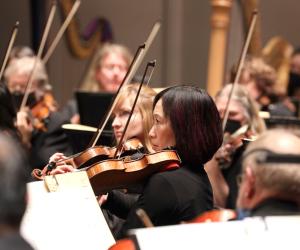
What makes live music so moving? Audiences might have wondered last month, as three Bay Area organizations presented extraordinary performances within the space of little more than a week. First came Mahler’s Symphony No. 8, performed by the San Francisco Symphony at Davies Symphony Hall; also that weekend, the San Francisco Opera revived Puccini’s La Bohème. A few days later, Cal Performances introduced Peter Sellars’ staging of György Kurtág’s Kafka Fragments at Zellerbach Playhouse, with the great Dawn Upshaw as vocal soloist.

Dawn Upshaw in Kafka Fragments

The events themselves couldn’t have been more diverse. Mahler’s massive opus, subtitled “Symphony of a Thousand,” calls for enormous forces, and conductor Michael Tilson Thomas melded the orchestra, the S.F. Symphony Chorus, the S.F. Girls Chorus, the Pacific Boychoir, and a stellar team of vocal soloists in a transcendent, gloriously outsized reading. La Bohème, with a fine cast headed by soprano Angela Gheorghiu, emerged newly energized under the fervent leadership of Music Director–designate Nicola Luisotti. And Kurtág’s miniature settings of Kafka’s texts, as delivered by Upshaw and violinist Geoff Nuttall, came across sounding remarkably incisive.

Yet, as different as these performances were — the hair-raising sonic magnitude of the Mahler, the enveloping warmth of Bohème, the focused intensity of the Kurtág — something was strikingly similar about all three. It was a heightened immediacy, a direct transmission from artist to audience. It was the sense that these works, despite all knowledge to the contrary, were being created on the spot.

Anyone attending a great performance knows the feeling. Some describe it as electric. For others, it’s a sense of total immersion. But what really happens when we hear music live? What is it, in this era of iPods, MP3 players, and YouTube videos, that continues to make the live experience essential?

Part of it is strictly visceral. It’s the excitement of witnessing the music unfold in the moment, the emotion we feel as any work creates tension and grants resolution. Along the way, there’s an element of risk: Will the tenor hit that high C? Will the string quartet pull off the composer’s most difficult passagework? Can the conductor find his or her way to the heart of the piece? It’s a little like watching a high-wire act, with all the implied danger and hope for a successful outcome.

Another aspect, acousticians will tell you, has to do with the quantifiable properties of live music. When we listen to a live orchestra, for example, the sound generated is rich, complex, multidirectional, with each instrument producing a signal that travels directly to our ears. Recorded sound, in contrast, is subject to diverse methods of processing and compression. It’s the difference, in visual terms, between seeing a live, three-dimensional person standing in front of you and viewing a photograph. Speaker quality and placement can also greatly affect the way we perceive the sound of a recording.

All of which suggests that when people say they’ve experienced a performance that no recording could capture, they’re probably right.

The Science of Hearing Music

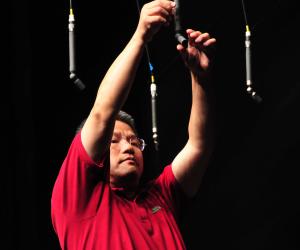
According to Jonathan Berger, a composer and professor of music at Stanford University who has spent much of his career studying the impact of music on the brain, live performance has a certain quality that can elude the most sophisticated recordings.

Jonathan Berger

“Even from the standpoint of one who works with electronic media,” says Berger, “and who would very much hesitate to state that live music is better than not-live music, there’s no current audio technology — even the best-of-best speakers, the best-of-best microphones — that can replicate the complex acoustic richness that’s created in a live environment.”

That’s not to say that technology isn’t useful (like most music writers, my own shelves overflow with CDs, MP3s, 33-1/3 LPs, cassettes, even some stray reel-to-reel tapes). Berger, whose projects include “Music and the Brain” — a network of studies on music and cognition — points out the value of seminal performances and new technology. “Would you rather listen to Glenn Gould’s recording of The Art of Fugue,” he asks, “or would you rather listen to a second-rate pianist’s live performance of it?”

Images of the brain on music

For first-rate listening, you certainly didn’t need to venture out to hear the works in last month’s performances. There are recordings aplenty of Bohème and Mahler’s Eighth on the market, with another on the way: The San Francisco Symphony’s digital recorders were running throughout the Mahler concerts, and the CD, due out next fall, promises to be one for the ages. At least one good recording of Kurtág’s Fragments is available, though I hope that Upshaw and violinist Nuttall will commit their extraordinary interpretation to disc.

Still, the evidence suggests that our ears, when given a choice, prefer live music to recorded.

Berger cites an experiment conducted in his lab with a computer-driven acoustic piano — a sophisticated “player piano” capable of reproducing what a human performer has played. “We did two recordings,” says Berger, “one of the live performer and one of the computer-generated performance. Both recordings were, for all practical purposes, identical, with the exception of incredible subtleties.” (These included breathing, the sound of fingernails hitting the keys, and noise from the piano bench.) “Then we did a preference test, and lo and behold, the preference for the recording of the live performer was clearly, statistically higher.”

This defies logic. The computer-generated recording, after all, was cleaner, without flaws or distracting “human” noise. Asked to explain the result, Berger says the answer is complex. “But I think that there is this sense that, when we listen to music, we try to associate it with humans creating it.”

Sharing the Act of Listening

And, perhaps, with other humans experiencing it. There’s a communal aspect to live performance that can’t be overlooked. Listening as part of an audience — whether it’s a group of 50, 100, or 3,000 — may be one of the most rewarding things we can do. It makes us feel connected (that’s a feeling you don’t get on a BART train full of iPod wearers). It makes us feel energized. It makes us feel human.

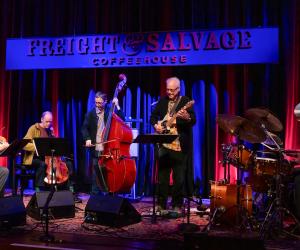
Of course, the venue plays a significant part in the experience. Here’s another aspect in which Bay Area audiences have an edge. Within a hundred-mile radius in and around San Francisco, it’s possible to hear music in an astonishing variety of settings, from Davies Symphony Hall, the War Memorial Opera House, Zellerbach Hall, and Stanford’s Memorial Auditorium to tiny chamber music venues such as Freight and Salvage, and the Hotel Rex. In between, there are many congenial midsized houses. For many, UC Berkeley’s Hertz Hall is the preferred space for vocal recitals. The Paramount Theatre in Oakland, the Cowell Theater at Fort Mason, the California Theatre in San Jose, and the Hofmann Theatre at Walnut Creek’s Lesher Center for the Arts are all employed, to good effect, for regional opera and symphony performances. And dozens of low-cost (or free) performances are given every weekend in community churches around the Bay Area.

There’s a wealth of music out there. This week alone, it’s possible to hear the Berkeley Symphony playing Adams and Beethoven (Dec. 18, Zellerbach Hall); the American Bach Soloists performing Handel’s Messiah (Dec. 18-19, Grace Cathedral); the San Francisco Girls Chorus singing Poulenc (Dec. 19, St. Mark’s Episcopal Church in Berkeley); “Pomegranates and Figs, a Feast of Jewish Music” (Dec. 20, Zellerbach Hall) with a women’s ensemble plus a klezmer band; and the Berkeley Community Chorus, in a program of opera choruses that includes selections from Philip Glass’ opera Appomattox (Dec. 21, St. Joseph the Worker Church).

All of these are wonderful programs, with endless possibilities — for the size of the hall, a larger or smaller ensemble, a slight change in focus or interpretation, will make each performance unique. How could it be different? Each will be live, performed in the moment by living, breathing artists. Even if it’s a work you know by heart, we’re betting you’ll hear it differently this time.

But don’t take our word for it. Go out, listen, and decide for yourself.


Georgia Rowe is a Bay Area arts writer. Her work has appeared in Opera News, Gramophone, The San Jose Mercury News, The Oakland Tribune, The San Francisco Examiner, and The Contra Costa Times.

©2008 By Georgia Rowe, all rights reserved.

Bookmark this article at: http://www.sfcv.org/2008/12/16/truth-and-daring-the-lure-of-live-performance/


Comments

  1. Unless I missed it, Georgia fails to note the main difference between attending a performance and listening to a recording of that same performance: you can see the performers. We are visual creatures first and foremost, auditory second.

    The major failing in the music recording industry, classical in particular, is the paucity of DVDs in comparison to the number of CDs. The engagement with the music is amplified tenfold by seeing the musician(s) make that music.

    Being there live can be great, but we all know the pitfalls of numerous audience coughs, sneezes, candy wrappers unwrapping, programs rattling, etc.

    I prefer to pay a few bucks and rent a DVD or watch for free on TV a performance that puts me on stage up close and personal with the musician(s) and mutes the audience noise instead of the hassle and expense (prohibitive for many of us in these tough economic times) of attending a live concert.

    Of course, professional writers like Georgia usually get in for free, saving the $75-$100 ticket price (times two with a guest) for a prime orchestra seat. For the rest of us, that money can buy a lot of recorded music that will last a lifetime.

    Posted by Dave on December 16, 2008 at 11:24 pm

  2. Good point David, but I think most people would have a very difficult time just sitting and listening and concentrating on a concert while at home, surrounded by distractions. The concert situation “forces” you to sit and listen.

    I elaborate on my own article on the subject, at:

    http://www.broadstreetreview.com/index.php/main/article/The_case_for_live_classical_music

    Posted by Beeri on December 19, 2008 at 12:03 pm

  3. I find Ms. Rowe’s descriptions as to the differences and similarities of the 3 major recent performances brilliantly written.

    I found it interesting to read about Jonathan Berger’s studies of the brain and music.

    What a fantastic difference it is being at a live show vs listening to a recording. During live performances I occasionally close my eyes to fully FEEL the event, and not be distracted by my seeing. The powerful energy that surrounds me is not entirely visual. Oh, sure, I am enthralled watching, too.

    Georgia Rowe reminds us of the many low cost, and free, live music shows available. We don’t need to pay $75 for live music (or $700+ to hear and see the rich and famous).

    I live in Martinez, and our local joint, Armando’s, regularly hosts some of the leading Bay Area musicians, for a fraction of the cost ($5-$10).

    Thanks for this great article.

    Posted by E Jones on December 19, 2008 at 9:54 pm

  4. Having attended the Mahler, ‘Boheme’, and Kurtag, I couldn’t agree more… (and it’s 125 miles from Monterey (where I live) to the music…each way!

    Posted by David Gitin on December 29, 2008 at 9:35 am

Post a Comment

By posting, you agree to abide by SFCV's Code of Conduct and Terms of Service.

Join Our E-mail List

Sign up for or change your subscription to SFCV’s e-mail newsletters: The Week in Classical Music and Listening Ahead.


Reviews

symphony

Shout to Heaven

By Robert P. Commanday

Santa Rosa Symphony continues to make strides under Music Director Bruno Ferrandis, performing Haydn and Bach.

choral music

Brubeck’s Devotions’ and Brahms’ Lovesongs

By Dan Leeson

For their Christmas concert, Pacific Mozart Ensemble present a musical odd couple.

symphony

Taking the Grand Approach

By Noel Verzosa

The last of six conductors vying to take the helm of the Berkeley Symphony Orchestra, Joana Carneiro brings various strengths.

chamber music

Birthday Moods

By Jules Langert

Left Coast Chamber Ensemble celebrates works by Messiaen and Carter on the anniversary of their births.

opera

No Double Whammy

By Jeff Dunn

Jake Heggie's new opera spotlights mother-son-daughter dynamics at 10-year intervals.

chamber music

Viva la Revolution

By Beeri Moalem

Classical music gets played in an intense, populist way at the Revolution Cafe.

chamber orchestra

Holiday Cheer

By David Bratman

New Century Chamber Orchestra rings in the holidays, with lovely singing by Melody Moore and Schola Cantorum.

recital

Double Impact

By Heuwell Tircuit

The dazzling cellist Alisa Weilerstein and pianist Inon Barnatan simply blow their audience away.

choral music

Singing for the Joy of It

By Jason Victor Serinus

Voices of Musica Sacra celebrates the Christmas season with music by Rutter, Howells, Walton, and others.

more...

Announcements

Holiday Schedule

The next SFCV newsletter after the Holidays is Jan. 6.


Listening Ahead

Our Critics’ Choices of Upcoming Events
December 16 – 29, 2008


News

Hope and Promise for Sonoma County

By Robert P. Commanday

The attractive, capacious Green Music Center bodes well for Sonoma County, as well as Sonoma State University.


Music News

By Janos Gereben

  • Update: The Seven Percent 'Solution'
  • Boccanegra Opens 2009 Broadcasts
  • S.F. Behaved Better in the Last Depression
  • Of Budgets and Salaries
  • More From Chicken Little
  • Takács Quartet in Mill Valley
  • Valentin Berlinsky


Advertisement